
Saoirse is on the hard. In a cradle at the Dockland 5 boatyard in Whangarei. And I’m living onboard, something that I usually try to avoid at any cost. Every morning at 7 am I’m woken by a boatyard orchestra consisting of cranes, grinders, sanding machines and pressure washers. I’m then quickly reminded of that I have to climb down a ladder and make it to the communal bathroom before I can do what most of us have to do when we wake up. The reason for this is that unless you want to dispose of any waste water on the ground below the boat, you can’t use the toilets, showers or sinks onboard. And even if I was OK with letting some water drain under the boat I couldn’t as my entire 12 volt DC system, which runs most of the creature comforts onboard, has been disconnected.
But I’m not complaining, I’m getting a lot of really big boat projects done here. Many of them requiring skillsets and tools that I do not possess so I’ve hired at least five different companies to help me with rig work, stainless steel welding, complicated electric and electronic systems and building a new rudder. All of these contractors are very good but they are easily led astray by other clients unless I’m onboard and constantly remind them of that I’m on a schedule. I need Saoirse back in the water, with all new installations tested and commissioned, and ready to leave for Fiji in the middle of June. And before then I plan to sneak in a visit to Sweden as I haven’t seen friends and family for over a year and a half.
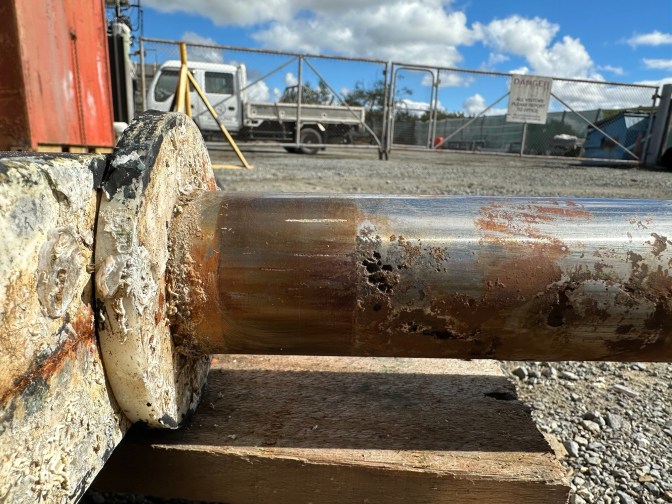
Most of the jobs here in Whangarei were planned. Either as repairs, improvements or just scheduled maintenance. One job that belongs in the latter category was to change the rudder bearings. There has never really been any indication of that anything was wrong, I just felt that it would be a good idea to have them replaced. This also allowed me to inspect the rudder stock and to my horror I noted some quite severe crevice corrosion. Possibly caused by the same electric stray current that damaged the foot of the mast during the Atlantic crossing. It’s hard to say how much this reduced the integrity of the stainless steel but losing your rudder is clearly one of the worst things that could happen on an ocean passage. The term MFL (Maximum Foreseeable Loss) from my risk management days springs to mind.
I may have been lucky to spot my rudder stock damage in time, but I’m afraid that wasn’t the case for a couple that I know on the Swedish yacht IdaLina. It was only a few days after my discovery that I started to hear that their boat sank 300 Nm from Marquesas. As I understand it, their rudder stock sheared off above the water line but the lower parts of the rudder made a huge hole in the boat as the blade banged from side to side. Fortunately they were rescued in their life raft and they posted this video on YouTube. Not for the faint hearted…
Discover more from Saoirse
Subscribe to get the latest posts sent to your email.

 Saoirse
You can take the guy out of risk management….Good MFL analysis Tom although I’m guessing the BI is somewhat more than a “Bloody Inconvenience” as your friends sadly found. Thank goodness for EPIRB I’m guessing and good Emergency Planning I’m sure. I hope they are as well as can be expected in the circumstances.
Enjoy the rest of your NZ adventure – that time is going very fast.
LikeLike
I was very sad to hear about their loss of their boat, home and dream. All we can do is to try to prepare, repair and maintain our boats. But at the end of the day ‘shit can happen’ and you may have to rely on things like Epirbs and life rafts. All the best. Tom
LikeLike